What is articulation carryover tracking?
Articulation carryover tracking is a way for a speech-language pathologist to see the home practice a child does between sessions, per target sound, tied to the specific child. Instead of asking a parent how the week went and working from their recollection, the clinician has a record of what was practiced and the recordings behind it. The record covers what happened. What it means for the child stays the clinician's call.
Why it matters
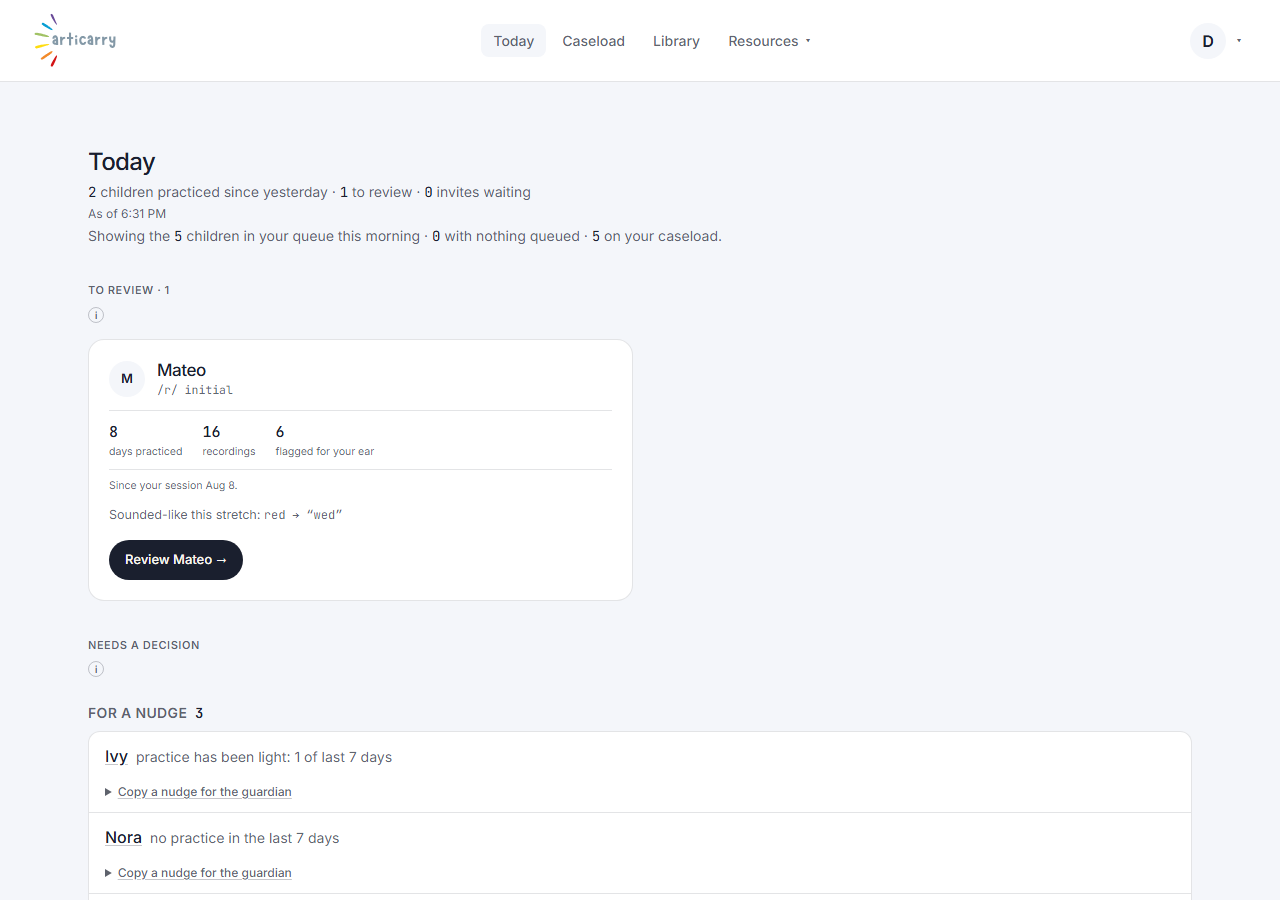
The work of articulation therapy does not stop when a session ends. Most of the practice you assign happens at home, between visits, where you cannot see it. That leaves a gap. You assign practice, and later you find out how it went secondhand. Carryover tracking closes the gap by keeping a per-phoneme record of the practice that was assigned and the recordings a child made doing it, so the days between sessions stop being a blank.
How is this different from a worksheet packet or a star chart?
A paper log tells you a child practiced. It cannot tell you what the practice sounded like, or which sound it was on. Carryover tracking keeps the recordings, tied to the specific target, so the practice between sessions is something you can hear rather than something you take on faith.
What does it track?
The practice a child was assigned, and what actually happened with it. How many of the assigned days the child practiced, which target sounds those days covered, and the recording behind each one. It counts practice. It keeps no points and no standing for the child.
Does it score the child?
No. The recording gets scored. The child does not. The record can point out where a sound may be worth your ear, whether it sounded like the target or sounded like something else, and it leaves every judgment about the child with you. It makes no clinical claim about the child.
Who is it for?
Private-practice speech-language pathologists doing articulation work, who assign home practice and want to see, per phoneme, what happened in the days between sessions.
What sounds does it cover?
Every target sound the practice library covers: the late-acquired English sounds and the major blend families, across word positions. It holds the plan you set. What it is not built for is listed on the clinical scope page.
What does it cost, and what does the family have to do?
It is free for the private-practice SLPs in the beta. The family opens a link and hands the child the device: no account for a parent to create, nothing to install, and no score shown to the parent. Your own time goes into listening rather than setup, because the caseload is sorted by who needs your ear first.
Does it replace any of the clinician's work?
No. It is a record of practice between sessions and nothing more. It decides nothing about a child's speech. Articarry is the adherence and carryover layer. The clinical work stays where it belongs.
Articarry is in private beta with a first cohort of private-practice SLPs. During the beta it takes synthetic, your own voice, or explicitly consented practice audio only. You can walk through a sample caseload without an account, where the sample child's clips are synthetic stand-ins, or join the waitlist for early access.
What Articarry is not built for is stated just as plainly on the clinical scope page.